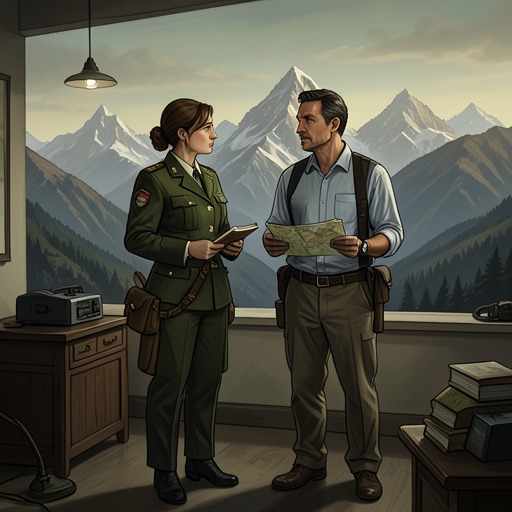
“The situation”: stigma surrounding Icelandic women’s relationships with American servicemen
Operation NapoleonThe stigma surrounding Icelandic women’s relationships with American servicemen is a social force that reaches beyond private choice: it makes intimacy subject to public shame, and leaves both Kristín and Steve and Michael Thompson and Tobba negotiating the boundary between personal attachment and the military base’s separation from Icelandic life. The novel traces that judgment to the arrival of foreign soldiers during the Second World War, then shows it persisting in relationships formed decades later. Its effects are not identical for every person, but the stories make clear how rumor and condemnation can narrow the space in which affection is allowed to develop.
Historical Roots and Public Judgment
The account links the stigma to the Second World War, when the first foreign soldiers arrived in Iceland. Some Icelandic women welcomed them in the hope of finding a route to a brighter future or a new life overseas; others were drawn to their uniforms and foreign manners, familiar from films, or to the cigarettes, nylons, and good times associated with the servicemen. The text presents this history as complicated rather than uniform: attraction could involve romance, material goods, admiration, or the possibility of leaving, while the public response reduced women’s relationships with soldiers to a source of shame.
That response took a gendered form. Women who slept with servicemen were branded as sluts, and the epithet Yankee whores condensed the judgment into a phrase that marked the women rather than the men involved. The shame attached to what the text calls the situation was not merely a matter of private disapproval; it was a public stigma directed at women’s sexual and romantic choices. Kristín believes that this attitude has changed little over the years, making the wartime origin less a closed historical episode than an inheritance that continues to govern later encounters.
Kristín and Steve
The stigma becomes immediate when Kristín recalls the beginning of her relationship with Steve. They had met through their official work, and he had eventually asked her to dinner. After two dates at restaurants in Reykjavík, he invited her to the officers’ mess at the base for their third date, followed by a drink at his apartment. Steve was considerate, but once they were alone Kristín’s confidence vanished. She panicked at the prospect of going to bed with an American on the base, where the social meaning of such an encounter seemed to overwhelm the care he was showing her.
Her reaction was shaped by the degrading stories told about Icelandic women who became involved with American servicemen. When she tried to explain her fear, Steve was hurt that she seemed to regard him through that stereotype. She left, and their meetings gradually became less frequent. Neither gave the relationship a definitive ending: after six months without speaking, they had still not formally called it over. The stigma therefore acts not as a simple prohibition imposed by an outside authority, but as a force that enters an intimate conversation and alters what each person thinks the other sees. Kristín’s fear and Steve’s hurt both matter, yet the social judgment falls most heavily on her, because she anticipates being classified by the relationship itself.
Michael Thompson and Tobba
Michael Thompson’s story offers a longer view of the same pressure. He remembers Tobba, whose full name was Thorgerdur Kristmundsdóttir, as an Icelandic woman who taught him the language. She was married and would not leave her husband. They met through her work at the store on the base, a place that made contact possible even though the base was otherwise a distinct community, cut off geographically, politically, and culturally from the rest of Iceland. As Thompson tells it, his interest in Iceland grew alongside his attachment to Tobba.
Whispers that she was involved with a Yank followed. Thompson’s recollection presents the rumor as a perilous public judgment for an Icelandic woman, even though Tobba did not intend to leave her husband. The account does not specify what consequences the whispers had for her, and it does not establish that she and Thompson had a relationship beyond the attachment and suspicion he describes. That distinction matters: the stigma operates through talk and the threat of disgrace, not only through confirmed sexual relationships. Tobba died several years before Thompson recounts the story, but his memory of her remains bound to the place where they met and to the social danger that surrounded their connection.
Persistence and Consequence
Thompson’s life in Iceland shows that the effects of this connection extended beyond the period of his work at the base. He had to apply to remain every three years. After Tobba’s death, he did not know where else to go; the authorities granted him a special dispensation and eventually stopped requiring repeated applications. He travelled around the country in summer and had worked as a guide for small groups of servicemen, taking them to historical sites as well as familiar tourist destinations such as Gullfoss, Geysir, and Thingvellir. He sometimes visited Tobba at the cemetery. His continuing attachment to Iceland is thus described through concrete acts of staying, travelling, and remembering, rather than as a resolution of the stigma itself.
The contrast between the two stories gives the concept its reach. Kristín and Steve’s relationship dwindles after an encounter shaped by anticipated judgment; Thompson’s account looks back on a bond marked by rumor and continued in memory after Tobba’s death. In both, the base is a point of contact between Icelanders and American servicemen, but not a socially neutral one. The stigma makes women’s reputations vulnerable to public interpretation, while men can recount their attachments without being described as subject to the same sexual condemnation. By placing a private hesitation beside a remembered lifetime in Iceland, the novel shows how a wartime legacy can persist in ordinary relationships, influencing what people dare to attempt and how they understand one another.